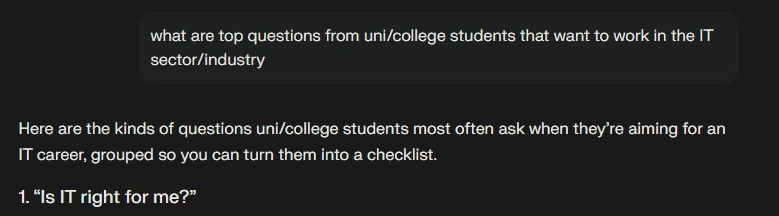
- This post will focus on people and workforce IT skills (Refer to pt. 1, for technical opinions)
- What does a typical day look like in an IT ops/engineering / Application support role?
- I perform a morning / daily check of my systems
- Log into AWS console check ECS stacks, check all my lambda’s have run, perform some nslookup and ping commands to confirm my destination endpoints are available
- Attend a morning meeting to review issues in the last 24 hours
- Confirm there are resources available and no blockers occuring
- I listen to all issues and question to myself if these issues will affect me at some point
- Confirm there are resources available and no blockers occuring
- Attend product and service meetings. Discuss some new features, limitations, upgrades and updates to our AWS stacks, provide advice and knowledge to other IT teams that interact with my ECS services
- Attend to major incidents, provide expertise and knowledge to unblock teams so the incident can be resolved asap
- Be on call to attend for any issues
- I perform a morning / daily check of my systems
- Can I switch roles later (e.g., from IT support to software dev)?
- Of course! Nothing in the rule book stating you can’t switch roles later
- It’s called moving sideways, which is better than moving up if you don’t want to be in a management position
- I recently moved from a application support role to a support devops role
- Basically I’ve moved from a customer solving position to a more backend troubleshooting position, where I assist senior devops on the detail of our systems
- Of course! Nothing in the rule book stating you can’t switch roles later
- Is IT still a good career long-term, or will AI replace it?
- No AI system will replace what’s in your head. I always say this about AI. If AI is so smart, can it inform major stakeholders of P1 and P2 issues, can it form proper messages to these stakeholders and explain technical jargon and terms, can it conduct bridges and meetings and delegate difficult tasks?
- The answer to this is no. We still need human beings, IT users and proper face to face communication.
- So in short IT is still a very solid of not fulfilling career and no AI won’t replace you
- (Provided you use AI for your learning and improving, and know that you’ll need to move along with the times)
- No AI system will replace what’s in your head. I always say this about AI. If AI is so smart, can it inform major stakeholders of P1 and P2 issues, can it form proper messages to these stakeholders and explain technical jargon and terms, can it conduct bridges and meetings and delegate difficult tasks?
- Everyone else seems better than me—am I behind?
- I don’t believe anyone is ever behind. You only know what you know at the time of asking
- The first thing to do is to read my articles on my website 🙂 You’ll defintely get ahead
- I provide all the latest trends, know how’s, small details and skills to get ahead of your peers
- You need to know more than your subject matter. If you only know coding you need to know about building your functions backwards (not just forwards), if you’re an IT network engineer you need to be familiar with the applications that have their traffic flow between devices, paths, firewalls, if you want to get into IT application support, you need to master the application/service you’re going to support etc
- I’m not talking about taking another course or degree, but knowing an extra 10-15% outside your domain is a must
- What if I don’t enjoy coding?
- Great this is me as well (well I’m not a professional coder, and I can read a bit of code (this is my extra 10-15% outside my domain)
- IT is a vast ecosystem, don’t think you need to pigeon hole yourself to learning one side of IT
- My greatest thing I can share and answer this is to learn IT systems (think I’ve mentioned this a few times 🙂 )
- Actually knowing systems and having the questions ready, to ask about these systems will put you in a great position
- At the end of the day it doesn’t matter what system you code, network or (project) manage, the variables and concepts will be the same
Summary:
- Everyone has a place in IT
- You need to continue to learn IT outside your domain
- Don’t think only certifications and degrees will land you a job
- Those days are gone imo
- Don’t think only certifications and degrees will land you a job
- Emphasise your desire and keenness to keep learning
- Also provide examples around this, and articulate your learning journey (and struggles)
 Alt+Ctrl+Start