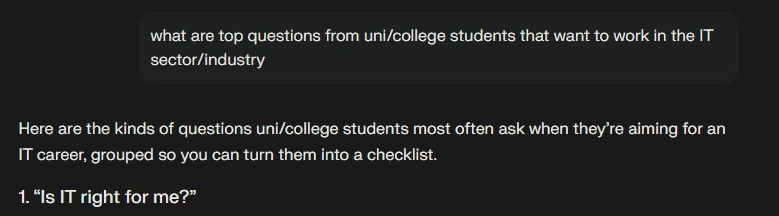
- This post will focus on mainly technical questions, pt. 2 will be focused on people and workplace skills
- What skills or personality traits suit an IT career?
- Sound troubleshooting skills
- Willingness to actually use the mind and brain and reach a level of deep thinking not applied in the tech or any industry
- No this doesn’t mean slave away on an issue for hours, but being able to comfortably apply troubleshooting based on what you know
- Willingness to actually use the mind and brain and reach a level of deep thinking not applied in the tech or any industry
- Willingness to not just learn what’s in front of them, but also willingness to get involved outside their subject matter expertise
- Sound troubleshooting skills
- How mathematical/technical do I really need to be for different IT paths?
- Mathematically none, you’re not solving a numbers equation, you’re solving a technical, software, networking, tech problem
- Knowledge on actual IT is needed
- Technical skills are obtained through knowing IT systems
- Master logistical IT. E.g. API’s talk to interfaces, packet traffic travels through different IP’s and DNS, knowing the application dependencies
- Mathematically none, you’re not solving a numbers equation, you’re solving a technical, software, networking, tech problem
- Do I really need a degree, or are bootcamps/certifications + experience enough for certain roles?
- Probably the most common question today, not just in tech but literally every other indsutry
- Related to the previous point above, master technical knowledge of IT
- A piece of paper from a college or university or completed bootcamp course is just that, a qualification and paper
- Read, research, and understand actual IT systems. You can then add to your resume and cover letter
- “I watched a yt video on IT networking. I’m familiar when a user types a URL (website address), there is something called DNS which translates into an IP which then serves the user the desired content”
- “I read an article that if a service is not running to check all the URL dependencies and confirm the destinations of these services are available”
- “When handling an IT case/job, I have to obtain what the IT user is trying achieve, where they want to go and if there is a reported issue, I actually need to know this function, and why it’s important to the user”
- The 3 answer’s above imply the uni grad has done some research into actual IT systems
- Which programming languages should I learn first?
- I’d say to this, just learn what you’re comfortable with but be prepared of the supply and demand of the particular language you intent to use
- Some languages will be popular than others
- The biggest advice I can provide for this is to also learn to code into the cloud (both at a software and cloud service level)
- Knowing how to actually use cloud services with code, imo will put your resume in the top 10%
- As a future employer the first thing I will ask is what’s your experience in coding in the cloud
- Knowing how to actually use cloud services with code, imo will put your resume in the top 10%
- I’d say to this, just learn what you’re comfortable with but be prepared of the supply and demand of the particular language you intent to use
Summary:
- Technical skills are great, but unless put into practice outside the workforce uni grads will all be competing at the same level
- Stand out and show your ability that you’ve researched and learned IT basics outside the classroom
- Regardless of what qualifications or coding skills you have, unless you’ve seen real examples of what you’ve learned is put into place (visually), it will always be difficult to grasp the real life IT workforce
- You can build a great website or app in a locally controlled environment but what about in an environment where there are dependencies outside your control?
 Alt+Ctrl+Start